

Duration: Varies
Recovery: Faster than open surgery
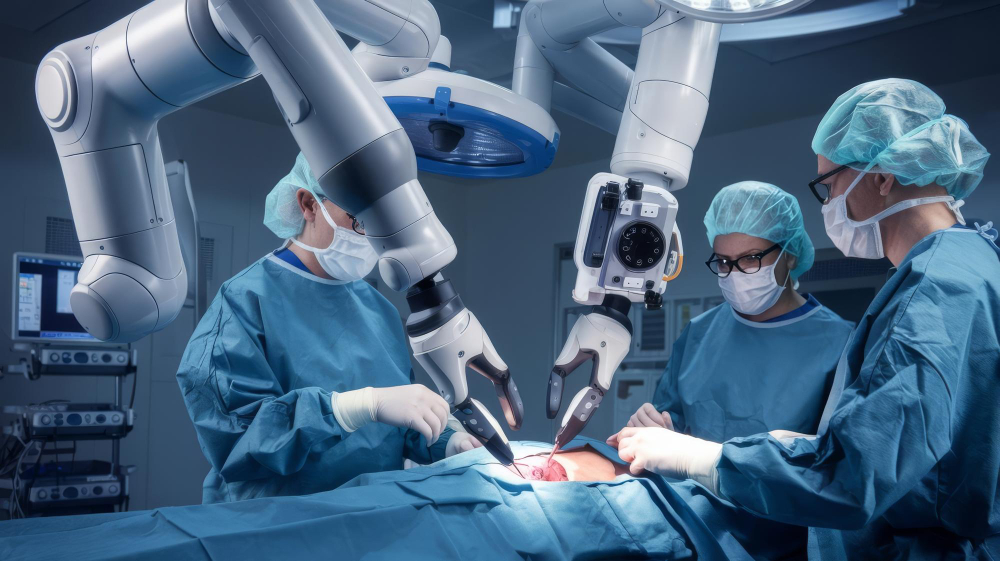
Robotic-assisted surgery uses a computer-controlled robotic system to augment the surgeon’s precision during joint replacement and other complex procedures. In orthopaedics, the robotic arm (such as the MAKO system) guides the surgeon to place implants with sub-millimetre accuracy based on a pre-operative 3D plan. The robot does not operate independently — the surgeon is in full control at all times. Studies show robotic-assisted joint replacement achieves more accurate implant positioning, more natural limb alignment, and potentially longer implant survival compared with conventional techniques.
Pre-operative CT scan (in addition to standard X-rays) is required for robotic planning.
All other preparation is the same as for conventional knee or hip replacement.
Same risks as conventional joint replacement (infection, DVT, stiffness)
Slightly longer operating time in some cases
The benefits over conventional surgery are still being confirmed by long-term studies
Your surgeon will discuss all risks with you before the procedure and take appropriate precautions to minimise them.
Post-operative care and physiotherapy are the same as for conventional joint replacement.
Many surgeons report that patients progress faster with robotic-assisted surgery, though protocols are similar.
Does the robot perform the surgery on its own?
No. The robotic arm is a precision tool that assists the surgeon — it does not operate independently. The surgeon is in complete control at all times.
Is robotic surgery available for all joints?
Robotic-assisted systems are currently most established for knee and hip replacement. Research into shoulder and ankle replacement with robotic assistance is ongoing.
Robotic-Assisted Surgery at Iswarya Hospital
At the forefront of advancements, offering robotic-assisted surgery for unmatched precision, safety, and faster recovery.
Welcome to my website. I’m Dr. Dinesh Ram, an orthopaedic surgeon committed to helping you move better and feel your best. If joint pain, injuries, or mobility issues are holding you back, I’m here to help you find lasting relief.



© 2026 Dr. Dineshram Devakumar. All Right Reserved.
Designed & Developed by  Innov Touch Technologies Pvt Ltd.

 dineshram1995.dr@gmail.com
 +91 97910 23456